
Wednesday, March 20, 2013
MINNEAPOLIS' UGLIEST BUILDING?
This is one of my favorite buildings in Minneapolis. It's so ugly that it's beautiful. Every time I look at this building, I wonder what is in this walled stucco mess.


Tuesday, March 19, 2013
CAR EXPERIMENTS
Lately I have been driving around in my car with a fistful of overhead transparency markers and stopping to trace buildings of interest. It's kind of hard to deal with the condensation and the concave nature of the window, but I think it will be a fun activity to start conversations around historic buildings.


Thursday, March 14, 2013
"AH HA" MOMENTS
Over the last month, I have been going to too many meetings and drinking too much coffee, but here's a list of "ah ha" moments that I have experienced lately.
1. Candy Chang

Last week I was in Denver on vacation and happened to notice that Candy Chang was giving a talk at the RedLine, a contemporary art center. I have been a fan of her work since my first exposure to her "Before I Die" project on the side of the Fallout Art Space in Whittier. I was taken by her desire to create her own discipline/career path. Her background is in urban planning, graphic design, and architecture and she utilizes all of these skills in her artistic practice. Much like Chang, I have a variety of interests and skills. The projects that I am most interested in working on don't exactly fit in the design realm, but feel more comfortable in space that art provides. Whatever the label, in the end, I hope to make stuff that sparks a conversation and action around ideas that effect people.
2. Jan Jacobs

When I started the CreativeCitymaking project, I asked artists, city planners, and architects that I know for books to read. The list that was compiled would be a great skeleton for Urban Planning 101 class. I have slowly be making my way through the list, but have resorted to playing audiobooks as I work. Lately I have been listening to The Death and Life of Great American Cities by Jan Jacobs via the Hennepin County Public Library's ebook system (a major "ah ha" moment in it's own regard). The book covers many topics in regards to urban planning, but Jacobs' thoughts on neighborhood and community based urban planning, safety on avenues, and the importance of a variety of buildings seem to speak directly to the project that I am working on as a part of CreativeCitymaking. A big portion of my project will occur on Central Avenue, a major commercial thoroughfare in Northeast Minneapolis. The Avenue faces many of the challenges (issues of safety, dominance of cars) that Jacobs outlines in her book, but also possesses many of the strengths (diversity of buildings, street life).
3. Trial and Error.

Making your sketches a reality is a process of trial and error. I am building a mobile tracing unit (see sketch above). The main idea is to crate a bike trailer out of an old door that can be propped up and trace buildings. I bought a door the other day at Bauer Brothers. I brought it home and decided to give it a fresh coat of paint. After applying a nice coat of white, I spent 4 hours taping down a stripe pattern and putting down a coat of orange paint. By this time I was about 6 hours into the project. I waited for the paint to dry, pulled off the tape, and realized that I had used water based paint on a oil based coat. No good. Total amateur mistake, but like most projects, this one is going to take twice the amount of time that I thought it would.
4. Holland Neighborhood Association & Edison High School

This point isn't necessarily an "ah ha" moment, but reinforces an "ah ha" moment. Last summer I realized that I had been working as an arts educator in every neighborhood aside from my own for the last 15 years. The CreativeCitymaking project has gave me the opportunity to work with teenagers in my own community. Over past month I have got to know much more about the students that go to school in my neighborhood and the people that are doing the day to day work to make my community better. Looking forward to continuing my partnerships with Edison High and the Holland Neighborhood Association.
Monday, January 28, 2013
HISTORIC PROPERTIES TOUR W/ CPED
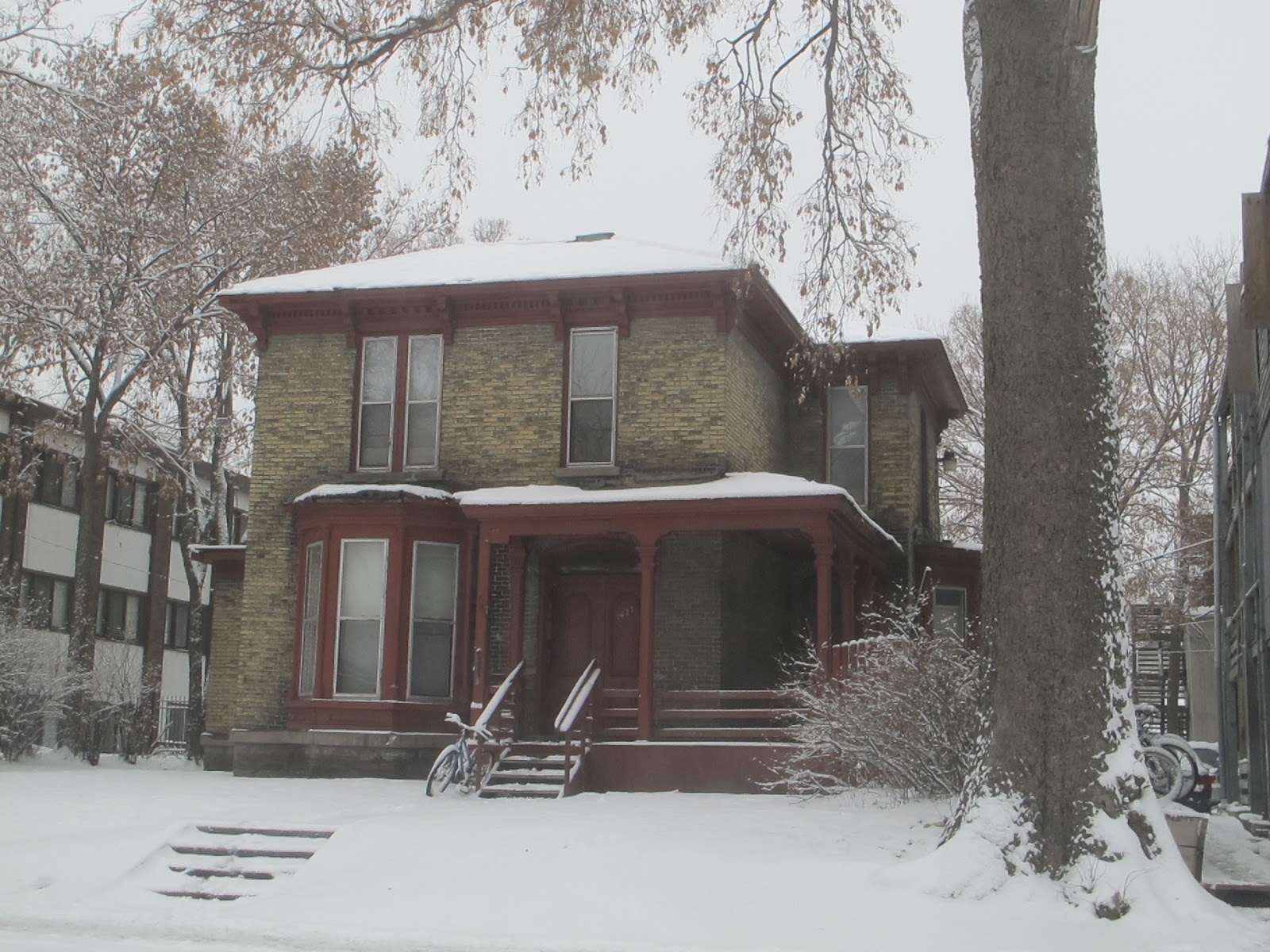
Got to spend the morning with Joe, Jack, and Mary touring historic sites in Minneapolis. We started off in Dinkytown and talked a bit about the impending residential and retail developments in the area. This house sits in the middle of several apartment complexes.

Next we travelled along Minnehaha and Hwy 55 and toured some of the developments that have been built in the last 5 years. We also talked a little bit about the challenges that the grain silos pose - as a historic property that symbolizes Minneapolis' agrian roots.

Next, we trudged through the snow to take a look at the Stevens House and the monument to Gunnar Wennerberg.


and then travelled to visit the Longfellow sculpture. It's interesting that the Henry Wadsworth Longfellow's name is all over Minneapolis, but the man never once stepped foot in Minneapolis.


Next we travelled along Minnehaha and Hwy 55 and toured some of the developments that have been built in the last 5 years. We also talked a little bit about the challenges that the grain silos pose - as a historic property that symbolizes Minneapolis' agrian roots.

Next, we trudged through the snow to take a look at the Stevens House and the monument to Gunnar Wennerberg.


and then travelled to visit the Longfellow sculpture. It's interesting that the Henry Wadsworth Longfellow's name is all over Minneapolis, but the man never once stepped foot in Minneapolis.


Friday, January 4, 2013
DEPT. OF CHANGE

Last Spring I created a project called The Department of Change. The project stemmed from a house on my block and my encounters with city processes. After doing a bit of research, I discovered that the house was in a condemned state. In most people's minds (including myself) condemnation means "this house will be torn down." According to the City of Minneapolis this is not the case. Condemnation just means it sits there till enough people complain about it. This particular house had been vacant for years. As an artist I wanted to approach problem by asking myself, "How can art and design solve this problem?" My answer was a hand screenprinted realty sign that simply stated, “THIS HOUSE SHOULD BE DEMOLISHED.” The sign was meant to build awareness around the house's status and to shed some light onto the process for getting it razed or preserved. I know that demolition is not the answer to the majority of the condemned buildings in Minneapolis, but at the time I strongly believed that this house needed to be knocked down.
As a part of the CreativeCitymkaing, I have been selected to work with The City of Minneapolis’ Community Planning and Economic Development department on a survey of historic Minneapolis structures and landscapes. Over the last couple months I have been trying to immerse myself in books, video, and interviews about city planning and Minneapolis history. One of most informative resources that I have come across is The Lost Twin Cities, a book written by Twin Cities’ historian Larry Millet. The book inspired a TPT series of videos with the same name.
Irony has a way of working itself into art. A couple weeks ago I was watching the Lost Twin Cities in my living room when suddenly my house started to shake. I quickly ran upstairs and observed a massive excavator destroying the condemned house. A queasy feeling hit my stomach, a physical unease that made me question what I had set in motion.

Was I wrong to want this building removed? The only solace I have is the knowledge that I wasn’t the only person in the neighborhood that felt this way. The sign was a signal to the neighborhood to do something and the neighbors responded with their emails, phone calls, and letters.
In the coming year, I’m excited that the CreativeCitymaking project will allow me to explore the question of “What is worth saving?” I hope to work with CPED to spur discussions Minneapolis history and what find out what Minneapolitans find historically significant.
Subscribe to:
Posts (Atom)